
What the Roots Picnic Reminded Me About Creativity and Community
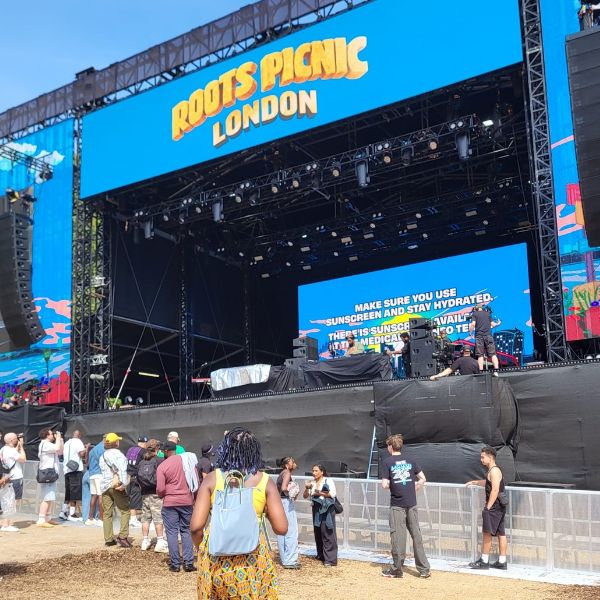
Dust covered my clothes and lined my nostrils, and with my Fitbit counting about 30,000 steps, I was exhausted. The two days at the London iteration of The Roots Picnic at Crystal Palace Bowl were a lot: everything I had hoped the Picnic would be and more. I watched artists I have listened to since my teenage ‘YFM RapActivity soundtracked days’ perform with the kind of skill, humour and ease that decades spent honing a craft gifts you. The Picnic was a celebration of pure hip-hop joy and community. By the end of the weekend, I was thinking as much about creativity, friendship and artistic tribes as I was about the music.
How it all began
Very eager, we alighted from our Croydon to Crystal Palace Overground train just after 1 p.m. The gates were only going to open at 2 but we like the other 50 or so crazy people began a queue in the blazing heat. And one of the first things to surprise me was the security.
The friendly but firm staff walked up and down the line offering to refill people’s water bottles. They were polite and respectful and it seemed like they care about our well being! And it was not a one-off. Throughout the performances, they offered people at the front cups of cold water.
P.S I should add that London was experiencing a menacing heatwave. We were allowed only a litre into the venue each, and that litre barely survived the train ride.
Hours later, as I hobbled back to the station thinking,
‘I might be too old for this,’
and cursing my impractical platform shoes, members of the security team said goodbye and wished us a very, very safe journey home.
A small thing, perhaps, but it set the tone for a weekend that increasingly felt less like attending a music festival and more like stepping into a community.
Back to the show.
Saturday ran like clockwork, with everyone but Yasiin Bey on stage when they were meant to be.
Questlove set the tone with a live set, followed by J.PERIOD’s Live Mixtape, which proved that Black Thought is indeed not of this world. Exemplifying what an MC is meant to be, he has mastered the craft: the words, breath control and the art of freestyling. His command of the stage and crowd was worth all the dust that blew into my nostrils, eyes and ears.
Common, whom I have been waiting to see live, appeared as a surprise guest with an energy that made you forget he has been performing for decades.
Rapsody made me realise I had probably been sleeping on her and needed to correct that immediately.
Then there were The Roots.
Captain Kirk. The tuba. The band moving effortlessly between sounds. Impeccable musicians who somehow still look as though they are simply having fun together.
Is there a better joy than witnessing your favourites still find pleasure in what they do?
Nas closed the night. It was my second time seeing him, and it was just as sweet.
A Fitting End
By 12.16 that night, I was lying in bed at our Travelodge in Croydon after attempting to wash the remains of the day away under a struggling shower. The seventh-floor room was a sauna, and its tiny old-school fan was about as effective as the low-pressure shower.
I was exhausted.
Record your feelings, I thought. Memory is unreliable; it polishes experiences, erasing the exhaustion and long queues.
So, despite the headache, I recorded a voice note. Somewhere between complaining about my feet, the dust and our journey back to Croydon, I called it one of the best days and nights of my life.
Day 2
There was no possibility of repeating Saturday at the same intensity, so Day Two was slower.
We arrived in time for Gott Street Park and Nina Jones before another highlight of the weekend: Robert Glasper jamming with Common, Questlove and James Poyser.
It was brilliant and absolutely hilarious. The chatter between Bilal, Common and Robert Glasper was witty and loose. There was teasing and laughing between songs, conversation bleeding into music and music back into conversation.
I marvelled at the history and ecosystem on that stage.
And about where all of this had begun.
From 2008
In 2008, The Roots launched what was then called the Roots Family Picnic in Philadelphia.
The idea was not simply another festival. It brought together music, Black culture and community while reflecting the breadth of the music we actually listened to.
That same year, I was nowhere near Philadelphia. I was in Port Elizabeth, now Gqeberha, doing my master’s at NMMU and avidly following Okayplayer.
I was not the type Talib Kweli referred to as
always have something to say like an Okayplayer hater,
but Okayplayer was part of my world.
Before every performance could be followed in real time on social media, I searched for bootlegged footage of The Roots performing around the world, downloaded it and played it to death, imagining myself there singing along.
The Roots Picnic always seemed distant.
Philadelphia. The Roots. A world I followed from a pentium computer in Port Elizabeth.
I never really imagined myself attending one.
Eighteen years later, I was standing a few steps away from Questlove, listening to him play in real life.
There is something about that which still gets me.
It Is Bigger Than Hip-Hop
I love good hip-hop.
It has helped hone my critical thinking. It has taught me to listen for references and wordplay, to question what was being said, and to look for context, contradictions and histories beneath the surface.
A song can send you towards another musician, a book, a political movement or an event you knew nothing about.
Hip-hop taught me that art could be enjoyable and intellectually demanding at the same time, and that meaningful art can affect people’s lives.
The Ecosystem
I bought Questlove’s *Creative Quest* last year and enjoyed it so much that I gave my sister a copy.
Seeing Roots Picnic made some of its ideas tangible.
The Roots emerged from a much wider community of artists, musicians, producers and thinkers whose paths crossed repeatedly through the 1990s and beyond.
They introduced one another to people and sounds. They collaborated and experimented. They built friendships.
And then they kept building.
Decades later, those relationships can produce a moment where Robert Glasper, Questlove, Common and James Poyser sit on a stage in London, make music together and spend half the time making themselves, and us, laugh.
And an idea can travel from Philadelphia to Crystal Palace and bring thousands of people with it.
The tribe around the talent matters.
Which made me think about mine
Writing is solitary. I have to sit alone with the page and my thoughts. Nobody can write the sentence for me.
But when I think about the periods in my life when I have felt most creatively alive, other people are usually somewhere in the picture.
Creative societies I belonged to when I was younger. Writing groups. People sharing work and recommending books. Conversations about art that stretched for hours. Someone else’s enthusiasm making you curious about something you might otherwise have ignored. Someone reading what you have written and seeing something you could not.
We talk a lot about finding your creative voice.
Perhaps we should talk more about finding your creative community: people whose values, talent, curiosity and vision challenge you to become better at what you do. People who expand your world.
Because clearly, the really interesting things begin when you find your people


Leave a Reply